


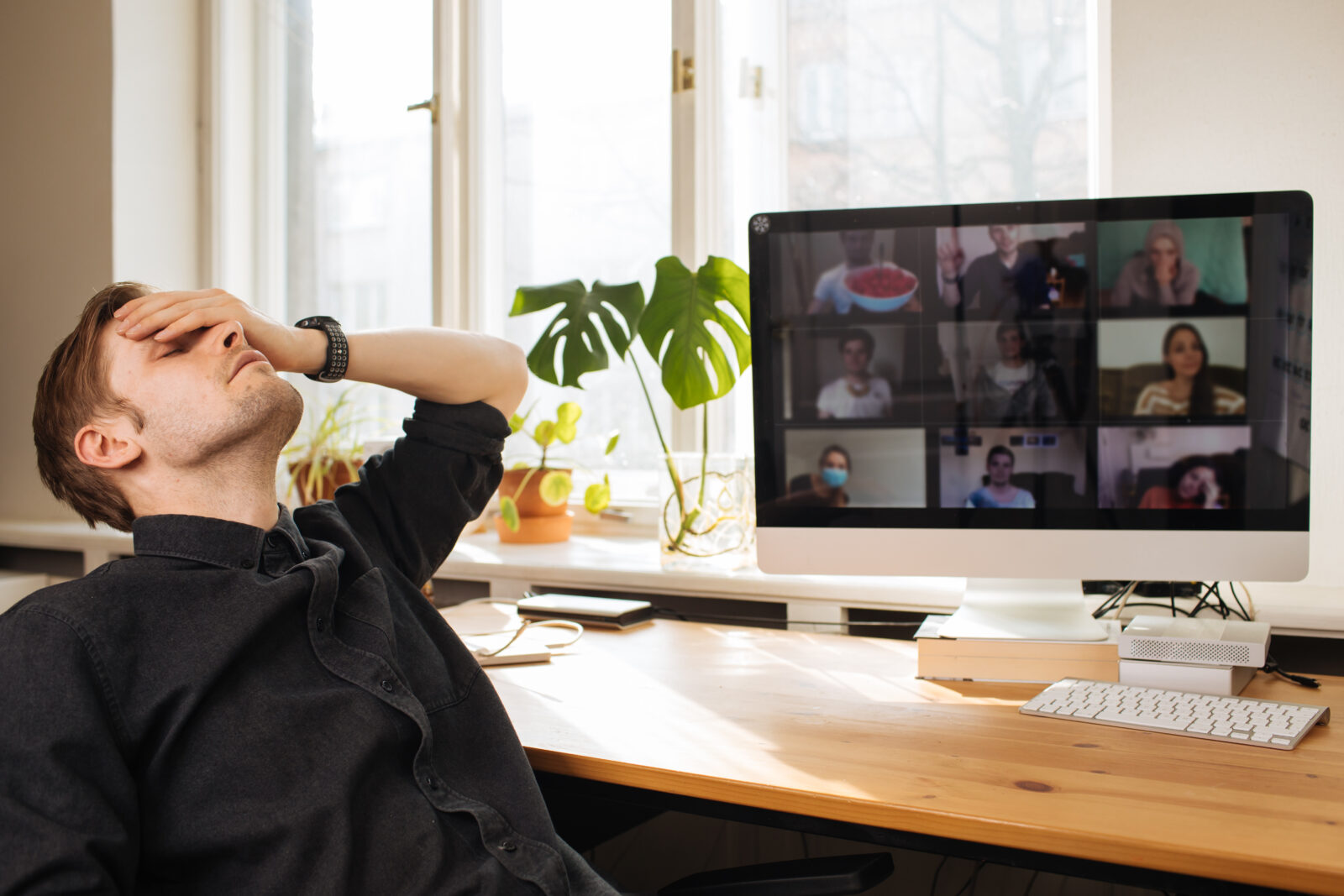


Why Online Meetings Feel More Draining Than In-Person Ones
Introduction
Over the last few years, video calls have gone from occasional tools to daily infrastructure. Meetings that once required travel, conference rooms, or phone calls now happen instantly with a link. On paper, this should make work easier. Yet many professionals report the opposite feeling: exhaustion, irritability, and mental fog after a day full of video calls.
This reaction is not a personal failure or a lack of discipline. There are specific cognitive and psychological reasons why online meetings feel more draining than in-person ones. The fatigue is real, measurable, and increasingly recognized by researchers, employers, and health professionals.
Understanding what is happening beneath the surface is the first step toward fixing it.
The hidden cognitive load of video calls
In face-to-face conversation, the brain processes information efficiently. Body language, eye contact, tone, and micro-expressions are read subconsciously. These cues reduce ambiguity and effort.
Video calls disrupt this system. Faces appear in boxes. Eye contact is simulated, not real. Gestures may be cropped or delayed. The brain must work harder to interpret meaning with incomplete signals.
Researchers at Stanford University’s Virtual Human Interaction Lab identified increased cognitive load as a core reason video calls cause fatigue. Their findings show that even small delays and distortions require additional mental processing. You can explore their research summary at https://vhil.stanford.edu.
This constant compensating effort accumulates over time, which is one major reason online meetings feel more draining during long workdays.
The stress of being constantly observed
In physical meetings, attention naturally shifts. People look away, take notes, glance at windows, or stretch. These movements are socially acceptable and largely unnoticed.
On video calls, participants feel permanently “on stage.” Even when not speaking, they are visible. This triggers mild performance stress similar to public speaking, but sustained over longer periods.
Psychologists refer to this as evaluation apprehension. The brain interprets constant visibility as a form of social monitoring, increasing stress hormones even in low-stakes meetings.
Seeing your own face amplifies this effect. Self-view encourages self-correction, posture monitoring, facial expression control, and appearance awareness, all of which consume mental energy.
The American Psychological Association has discussed how self-monitoring increases cognitive strain in digital interactions. Their workplace psychology insights are available at https://www.apa.org.
Reduced nonverbal feedback loops
In-person conversations rely heavily on feedback loops. A nod encourages continuation. A puzzled expression signals clarification is needed. Laughter reinforces connection.
Video calls flatten or delay these signals. Participants may be muted, frozen, or distracted. Speakers receive less immediate feedback and must guess whether their message is landing.
This uncertainty forces speakers to over-explain, repeat points, or increase vocal energy. Listeners, meanwhile, must concentrate harder to stay engaged without natural conversational rhythm.
Over time, this imbalance contributes to why online meetings feel more draining compared to physical interactions that flow more intuitively.
The multitasking illusion
Many people believe video meetings allow efficient multitasking. Emails, chats, and documents stay open. In reality, this divided attention increases mental fatigue.
Cognitive science shows that task switching carries a cost. Each switch requires the brain to reorient, suppress previous context, and load new information. The result is faster exhaustion and reduced comprehension.
Harvard Business Review has repeatedly highlighted how digital multitasking depletes cognitive resources rather than saving time. Their analysis of attention residue can be found at https://hbr.org.
During video calls, this effect is amplified because the brain is already under strain from visual processing and social monitoring.
Audio processing fatigue
Audio quality plays a larger role than most people realize. Even minor distortions, compression artifacts, or background noise force the brain to fill in gaps.
This phenomenon, known as listening effort, increases when sound is unclear or unnatural. The brain works harder to decode speech, leaving fewer resources for comprehension and memory.
In physical rooms, sound is spatial and directional. On video calls, audio is flattened and often inconsistent. Over hours, this contributes significantly to exhaustion.
Studies summarized by the National Institute for Occupational Safety and Health highlight how poor audio environments increase cognitive strain. Their occupational health resources are available at https://www.cdc.gov/niosh.
Why shorter meetings still feel exhausting
Many teams respond to fatigue by shortening meetings. While helpful, this alone does not solve the problem.
The issue is not just duration but density. Back-to-back video calls leave no cognitive recovery time. In physical workplaces, movement between rooms provided micro-breaks that allowed mental reset.
Without intentional gaps, the nervous system stays in a heightened state of alert. This explains why even a series of short calls can feel overwhelming by mid-afternoon.
Recognizing recovery time as part of productivity is essential to reducing why online meetings feel more draining across the workday.
The emotional disconnect factor
Humans are social creatures. In-person interaction satisfies emotional needs through subtle connection cues. Video calls often fail to meet this need fully.
As a result, people may feel paradoxically lonely after hours of meetings. Emotional energy is spent, but emotional fulfillment is low.
This mismatch creates a sense of emptiness rather than satisfaction, further intensifying fatigue and disengagement.
Workplace sociologists note that sustained digital interaction without meaningful connection can increase burnout risk. Insights on social energy and work can be found through resources like https://www.mckinsey.com.
The role of meeting culture, not just technology
Technology is only part of the problem. Meeting culture amplifies the strain.
Many organizations default to video for discussions that could be asynchronous. Others invite large groups where only a few people actively participate. Some meetings lack clear goals, agendas, or decision ownership.
When purpose is unclear, cognitive effort feels wasted. This perception increases frustration and exhaustion far more than productive challenge.
Addressing why online meetings feel more draining requires cultural change, not just better tools.
Practical ways to reduce meeting fatigue
Reducing fatigue does not mean eliminating collaboration. It means redesigning how interaction happens.
First, default to asynchronous communication when possible. Written updates allow people to process information at their own pace and reduce unnecessary meetings.
Second, turn off self-view. Most platforms allow this, and it significantly reduces self-monitoring stress.
Third, schedule buffer time between calls. Even five minutes of movement or silence allows the nervous system to reset.
Fourth, normalize audio-only meetings for discussions that do not require visual cues. Removing video reduces visual fatigue and social pressure.
Fifth, limit attendee lists. Smaller groups increase engagement and reduce the cognitive noise of large grids.
These changes address root causes rather than symptoms.
The manager’s role in reducing fatigue
Leaders shape norms. When managers model healthy meeting behavior, teams follow.
This includes questioning whether a meeting is necessary, ending early when goals are met, and protecting focus time. It also includes acknowledging fatigue as legitimate rather than framing it as a resilience issue.
Organizations that treat attention as a finite resource tend to see better long-term performance and morale.
Workplace well-being research from organizations like Gallup consistently links autonomy and respect for cognitive limits with engagement. Their findings are available at https://www.gallup.com.
Looking ahead: hybrid communication maturity
As hybrid work stabilizes, organizations are learning that digital communication requires different rules than physical interaction.
The goal is not to replicate in-person meetings on screens but to design communication that respects how the brain actually works.
When this shift happens, collaboration improves and exhaustion decreases. Understanding why online meetings feel more draining is the foundation for building healthier digital workplaces rather than temporary coping strategies.
Conclusion
Video meetings are not inherently bad. They are powerful tools when used intentionally. The problem arises when they are treated as frictionless replacements for all interaction.
Cognitive load, constant visibility, reduced feedback, and cultural habits combine to make online meetings feel more draining than many people expect. Recognizing these factors removes guilt and opens the door to better design.
Fatigue is not a weakness. It is feedback. Listening to it leads to smarter work.
Frequently Asked Questions
Why do I feel exhausted after video calls but not phone calls
Video adds visual processing, self-monitoring, and social pressure that audio-only calls do not require.
Does turning off the camera really help
Yes. Removing constant visual monitoring significantly reduces cognitive and emotional strain for many people.
Are introverts more affected by video meeting fatigue
Both introverts and extroverts experience fatigue, but introverts may feel it sooner due to sustained social stimulation.
How many video meetings per day is too many
There is no universal number, but back-to-back meetings without breaks increase fatigue regardless of duration.
Will hybrid work reduce this problem over time
Yes, if organizations intentionally redesign communication norms rather than defaulting to constant video interaction.