


Top Tech Trends Shaping the Final Month of 2025
Introduction: This Month Feels Like Sci-Fi
Tech trends 2025 have shifted from “cool” to “wait, are we living in a sci-fi pilot?” Because honestly, this month doesn’t feel like December anymore it feels like we quietly stepped into the future while checking our notifications.
There’s this surreal sense that everything familiar has gotten a subtle upgrade.
The other day, I tried to pinch and zoom the air above my desk to switch windows and didn’t realize my laptop was asleep the whole time. That’s the level of futuristic energy we’re dealing with.
The final month of 2025 isn’t just ending a year; it’s setting the stage for how we’ll live, work, travel, create, and even stay healthy in 2026. And if these trends are anything to go by… wow, we are in for a ride.
Let’s break down the biggest shifts shaping the tech landscape right now.
1. AI Agents Evolve Into Fully Autonomous Work Partners
Why December 2025 marks a turning point
If we had to crown a winner among tech trends 2025, AI agents would snag the title. What used to be simple chatbots are now fully autonomous digital workers capable of handling complex tasks without constant supervision.
This month, AI isn’t just answering prompts, it’s planning your day, running your research, drafting your content, cleaning your inbox, and generating reports before you wake up.
The real shift?
AI agents now collaborate with each other. Your scheduling agent talks to your research agent, who coordinates with your project agent. It’s like a digital team… except no one sends passive-aggressive emails.
How young professionals are using AI agents daily
- Junior marketers run automation agents to analyze ad performance
- Designers use multi-agent systems to ideate concepts
- Students let research agents compile summaries and sources
- Customer support teams deploy agents to triage tickets
- Developers offload debugging and documentation
AI is not replacing entry-level work it’s enhancing it, freeing humans to think instead of just grind.
2. Spatial Computing Becomes the New Normal
The rise of lightweight headsets and gesture-based control
Spatial computing is no longer a niche interest or a gaming gimmick. December 2025 is the month spatial tech finally “clicked” for the mainstream.
Headsets became lighter, interfaces stabilized, and apps learned how humans actually behave. Suddenly:
- You can pull up floating screens while commuting.
- Meetings take place around holographic dashboards.
- You move windows around like you’re conducting an orchestra.
Practical use cases reshaping productivity
Young professionals now use spatial tools to:
- brainstorm using virtual sticky notes
- review 3D prototypes
- multitask with multiple floating apps
- visualize dashboards around their actual workspace
The big win? It reduces digital clutter and increases focus something every overworked young professional appreciates.
3. Smarter, Sleeker Wearables Transform Personal Health
New biometric insights appearing in December 2025 devices
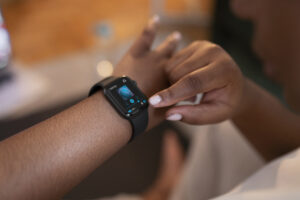
Wearables took a huge leap this month. Instead of just tracking steps or heart rate, 2025 devices offer:
- stress load forecasts
- micro-sleep detection
- hydration-level monitoring
- early warning signs for illnesses
- real-time recovery tracking
And they look good. Smart rings, thin wristbands, and skin patches replaced chunky fitness trackers.
This is one of those tech trends 2025 that people didn’t even realize they needed — until it started catching issues early.
How workplaces respond to health-driven data
Companies now use anonymized wellness data to:
- schedule meetings during peak focus times
- prevent burnout during crunch periods
- adjust shift rotations
- create better team rhythms
Healthy employees = better work culture.
Who knew?
4. Generative AI Reinvents Personal Media
Ultra-personalized content ecosystems
Remember when AI content felt robotic? Those days are long gone.
December 2025 has given us:
- personalized short films
- AI-generated podcasts in your preferred tone
- news summaries at your reading level
- custom learning modules
- on-demand workout videos based on your mood
The “For You Page” introduced algorithmic personalization. GenAI just blew the doors open.
What this means for creators and consumers
Creators gain tools to scale ideas faster.
Consumers get media tuned exactly to their preferences.
Brands reach micro-audiences with incredible precision.
We’re entering the era of you-specific entertainment — and honestly, it’s addicting.
5. Quantum-Boosted Cloud Tools Quietly Enter the Marketplace
Early quantum-assisted functions young pros are already touching
Let’s be clear: we’re not casually running quantum computers at home.
But major cloud platforms have quietly introduced quantum-enhanced features that optimize:
- logistics
- data analytics
- energy modeling
- scientific simulations
- financial predictions
You’ve probably already used a quantum-assisted service this month without realizing it.
Industries benefiting right now
- Climate science (weather models & carbon capture)
- Finance (portfolio optimization)
- Healthcare (drug discovery)
- Research labs (simulation-heavy studies)
This is one of those tech trends 2025 that’s subtle but powerful the kind that slowly reshapes entire industries.
6. Urban Mobility Shifts: Micro-EVs and AI-Optimized Travel
Smarter routing and adaptive city layouts
AI now predicts traffic flow in real time, adjusting:
- bus routes
- train schedules
- bike lane priority
- micro-EV corridors
Spatial navigation overlays show optimal routes as you walk, bike, or ride.
Cities are becoming smart organisms that adapt to human movement.
Why car-free living is trending among young adults
Between rising costs, parking nightmares, and smarter micro-mobility, young professionals are embracing:
- e-bikes
- foldable micro-EVs
- compact urban scooters
- shared autonomous pods
Freedom without the financial weight of car ownership?
Yes, please.
7. Cybersecurity Moves From Reactive to Predictive
AI-powered defense systems
With new threats emerging every day, cybersecurity had to evolve. December 2025 marks a turning point from reactive protection to proactive defense using AI that:
- spots unusual behavior
- flags anomalies
- identifies suspicious access patterns
- predicts risks before they escalate
Think of it as having a digital security guard who watches for problems before they happen.
Practical benefits for everyday users
Regular people benefit too through:
- smarter password prompts
- automatic suspicious-activity alerts
- safer home network scans
- risk-level dashboards
Digital safety is finally becoming accessible not just a corporate luxury.
8. Green Tech Innovations Become Everyday Utilities
Decarbonization tools powering homes and offices
Green tech quietly jumped ahead this month.
Homes are now equipped with:
- smart solar grids
- energy-optimizing meters
- AI-driven heating and cooling
- home energy predictions
It’s sustainability… without sacrificing convenience.
Corporate accountability through transparent data
Companies now use real-time carbon dashboards to:
- track emissions
- report sustainability progress
- optimize energy consumption
- make eco-friendly decisions backed by data
This isn’t branding anymore it’s measurable action.
Conclusion: December Sets the Stage for an Even Wilder 2026
The final month of 2025 isn’t just a calendar milestone. it’s a preview of what our tech-infused lives are becoming. From AI coworkers to holographic workspaces to personalized media and smarter cities, this year’s breakthroughs reshaped everything about modern life.
If this is how the year ends…
let’s see who 2026 turns us into.

🔗 External Resource:
Explore more emerging technologies at: https://www.wired.com


