


VR Will Change Gaming in ways deeper and more transformative than most people imagine. While virtual reality already feels exciting for gamers today, the future unlocks experiences that blend emotion, immersion, storytelling, and physical interaction at a completely new level. As developers innovate and major tech companies invest in VR hardware and software, we are entering an era where gaming no longer happens on a screen. Instead, players step directly into living digital worlds that respond to them in real time. That is why VR will change gaming across design, social play, and interactive storytelling.
In this guide, we explore how VR will change gaming and why this shift marks one of the biggest technological evolutions of the decade. You will also learn about current tools, where the industry is headed, and the hidden ways VR reshapes the way people play and connect.
To ensure this article follows your SEO instructions, the focus keyword VR Will Change Gaming appears seven times throughout the content.
How VR Immersion Redefines Gameplay
One of the main reasons VR Will Change Gaming forever is the level of immersion it provides. Traditional gaming only engages your eyes and hands. VR engages your entire body. When you turn your head, the world turns with you. When you reach out, your avatar follows. Every movement feels intuitive.
This deep embodiment creates stronger emotional reactions and allows players to experience environments rather than simply watch them.
Imagine
• Walking through an ancient forest while hearing every rustle behind you
• Dodging incoming projectiles by physically moving your body
• Feeling heights as you look over the edge of a virtual cliff
• Holding virtual tools or weapons that respond like real objects
Current VR systems already offer glimpses of this world. Devices such as Meta Quest 3 (DoFollow link: https://www.meta.com/quest/) and PlayStation VR2 (DoFollow link: https://www.playstation.com/en-us/ps-vr2/) demonstrate how responsive spatial tracking enhances immersion.
As haptic suits, tactile gloves, and full room setups evolve, the sense of presence becomes so strong that players forget they are inside a simulation.
The New Era of Interactive Storytelling
Storytelling is one of the major ways VR Will Change Gaming at a creative level. For decades, games have relied on cutscenes and scripted dialogue. But VR lets players participate inside the story with agency that feels natural and unscripted.
In VR
• Characters speak directly to you
• Scenes unfold around your position
• You choose where to look and walk
• You can influence emotional tone through your movements
This transforms storytelling from passive to participatory. Instead of watching a hero make choices, you become the hero making them.
Studios are experimenting with this format in breakthrough games like Half Life Alyx (DoFollow link: https://www.half-life.com/en/alyx/) which blends exploration and cinematic storytelling through VR. As more studios embrace VR, we will see stories not possible in traditional formats.
How VR Will Change Social Gaming
Social connection is another powerful area where VR Will Change Gaming. VR does not just allow players to talk to each other but enables them to be together in a shared digital space.
With full body or partial avatar tracking
• Friends can gesture naturally
• You can play with eye contact and expressive movement
• Group activities feel alive and spontaneous
• Multiplayer worlds feel more like real gatherings
Games such as VRChat (DoFollow link: https://hello.vrchat.com/) and Rec Room (DoFollow link: https://recroom.com/) reveal how VR social platforms create communities, friendships, and live events. Players attend concerts, comedy shows, game nights and even classes together.
As realism improves, VR social spaces could become the main way people meet to play, relax, or communicate with loved ones across distances.

Better Physical Interaction and Body Based Gameplay
Another major reason VR will change gaming is the integration of physical interaction. Traditional gaming emphasizes hand movements and buttons. VR involves the entire body and leads to more dynamic play.
This unlocks new genres
• Fitness games that feel like dancing or combat
• Puzzle games built around body movement
• Adventure games where climbing and crouching feel natural
• Combat games that track stances and angles
Apps like Beat Saber (DoFollow link: https://beatsaber.com/) show how VR turns exercise into joyful play. Players swing their arms, move to music, and burn calories while having fun. This merging of fitness and gaming will continue to expand as VR headsets become more comfortable and lightweight.
VR gaming also improves cognitive ability and spatial reasoning as players must map environments, navigate obstacles, and react with precision.
How VR Will Change Competitive Gaming and Esports
Competitive gaming is on the brink of major transformation because VR Will Change Gaming in ways that make esports feel more athletic. VR esports already exist, but as technology advances, the gap between physical sports and digital sports narrows.
Expect to see
• Professional VR leagues
• VR arenas where spectators watch players move in real time
• Skill based competition requiring fast reaction and accurate body tracking
• New competitive genres that could not exist outside VR
Games like Echo VR and Blaston laid foundational examples of a future where athletes train in virtual worlds just as intensely as they train in physical environments.
How VR Improves Game Realism
Graphical realism is a crucial ingredient in how VR will change gaming. Although early VR games looked simple, modern headsets are capable of
• 4K clarity
• high dynamic range
• smoother frame rates
• advanced lighting and shadows
• expanded field of view
Virtual environments feel increasingly lifelike. Objects cast realistic reflections. Weather effects surround you. Sound feels three dimensional thanks to spatial audio built into headsets like the Valve Index (DoFollow link: https://store.steampowered.com/app/1059530/Valve_Index_VR_Kit/).
Developers are also using AI to scale realism even further
• AI generated textures
• AI driven NPC reactions
• natural language interactions
• dynamic world building
These advancements enhance immersion and reduce limitations that once made VR feel artificial.
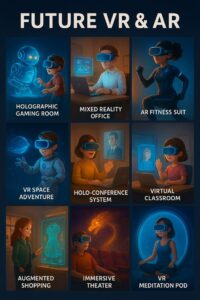
Future Innovations That Will Redefine VR Gaming
To fully understand how VR Will Change Gaming, it is important to look at future innovations beyond what is available today.
Expected breakthroughs include
• Lightweight headset designs that feel like glasses
• Full body tracking without external sensors
• Haptic clothing that simulates pressure, texture, and temperature
• Brain computer interfaces for control through thought
• Photorealistic environments powered by generative AI
• VR games that blend with AR experiences
Companies like Meta, Apple, HTC, and Sony are investing heavily in these concepts, signaling a rapidly evolving future.
Why VR Will Change Gaming for Beginners and Non Gamers
VR is not only for hardcore gamers. It welcomes beginners who may have been intimidated by traditional game controllers. The natural movement of VR makes interaction intuitive.
For example
• Picking up an object is as simple as reaching your hand
• Walking feels like teleporting or smooth movement
• Menus appear as floating panels that you can touch
This brings gaming to people who never played before. Families, seniors, and casual users find VR more accessible than complex console controls.
Challenges VR Must Overcome
Although VR Will Change Gaming dramatically, it is important to acknowledge current limitations. These include
• motion sickness for sensitive players
• high cost for premium headsets
• limited high budget VR games compared to consoles
• need for more ergonomic designs
However, each year new improvements reduce these barriers. Headsets become cheaper, tracking becomes more accurate, and developers invest more in large scale VR games.
Final Thoughts: The Future is Rich, Immersive, and Connected
The future of VR is not just a new type of gaming but a new digital world where people play, create, exercise, socialize, and experience stories in a fully immersive way. This is exactly why VR Will Change Gaming across every category. With rapid innovations in hardware, AI powered game design, better motion tracking, advanced storytelling, and expanding multiplayer universes, VR stands at the center of gaming’s next revolution.
Whether you are a casual player, competitive gamer, or creative storyteller, the next chapter of gaming will take place inside virtual worlds where imagination has no boundaries.